Wuxi Shibang Machinery Manufacturing Co., Ltd
Contact: Manager Zhou
Tel: + 86-510-85596218
Switchboard: + 86-510-83050666
E-mail: info@wxsbjx.com
Company website: www.wxsbjx.com
Address: Huishan District of Wuxi City Yangshan Industrial Zone Hengtong Road on the 7th
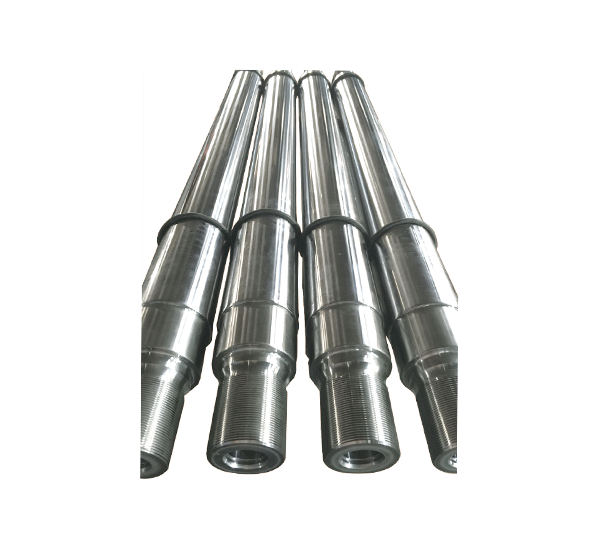
The piston rod is a connecting component that supports the piston to do work. It is mostly used in oil cylinders and cylinder motion execution components, and is a frequently moving and technically demanding moving component. Taking a hydraulic cylinder as an example, it consists of several parts: cylinder barrel, piston rod (cylinder rod), piston, and end cap. The quality of its processing directly affects the lifespan and reliability of the entire product. The processing requirements for piston rods are high, with a surface roughness requirement of Ra0.4-0.8um, and strict requirements for coaxiality and wear resistance. The basic characteristic of the oil cylinder rod is the processing of a slender shaft, which is difficult to process and has always troubled the processing personnel.
Thereby improving the surface corrosion resistance and delaying the generation or expansion of fatigue cracks, thus enhancing the fatigue strength of the oil cylinder rod. By rolling forming, a cold work hardening layer is formed on the rolling surface, reducing the elastic and plastic deformation of the contact surface of the grinding pair, thereby improving the wear resistance of the cylinder rod surface and avoiding burns caused by grinding. After rolling, the reduction of surface roughness value can improve the fitting properties. At the same time, it reduces the friction damage to the sealing ring or seal during the movement of the cylinder rod piston, and improves the overall service life of the cylinder. Rolling technology is a high-quality process measure.
Technical standards for piston rods:
(1) Piston rod tolerance size: F7-F9
(2) Surface roughness of piston rod: Ra value 0.3-0.6
(3) Surface hardness of piston rod: HRC58-64 Surface depth of piston rod: 1-3mm
(4) Piston rod machining accuracy: neck circular path 0.02-0.05
(5) Linearity of piston rod: 100m (error not exceeding 5um)
(6) Plating layer on piston rod: 0.025-0.035